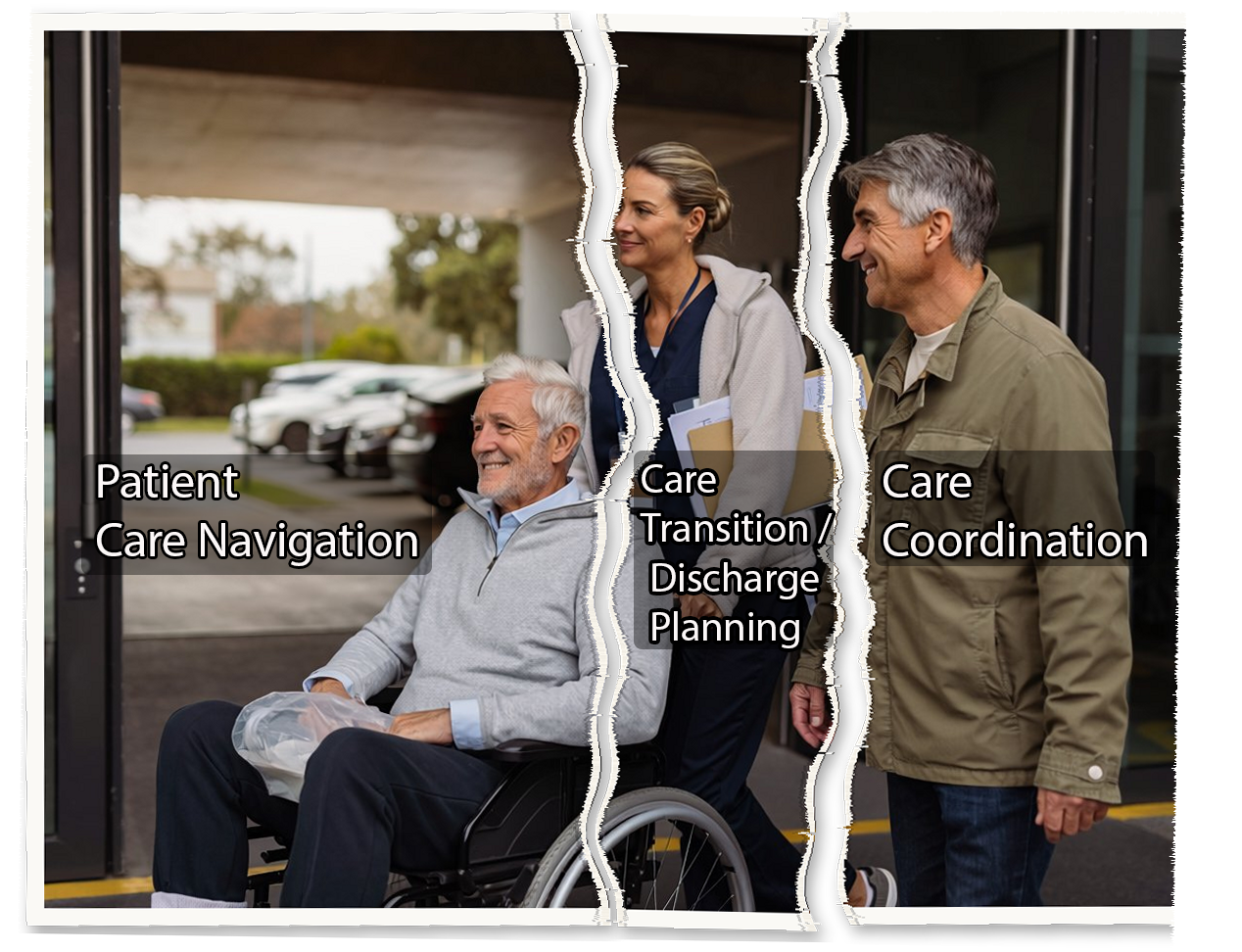

One care journey. Three torn systems.
Cohezon. A Care Continuum platform built to connect what no single EHR can: hospitals, post-acute providers, primary care, and the patients moving between them.


Each was built for one part of the journey, but patient outcomes require every part to connect.
Every tool in this space owns one part of the handoff. EHRs document care inside a single organization. Referral platforms move packets between inboxes. Navigation apps give patients information without clinical context. Each was built for one part of the journey, but patient outcomes require every part to connect.
Cohezon connects all four. One shared coordination layer where discharge planning, care transitions, care coordination, and patient navigation run on the same engine - by design, not integration.

The unnecessary costs after medical discharge
- Case managers still depend on chat, institutional knowledge, and faxes.
- 30% of post-acute referrals require follow-up, taxing staff resources.
- 20% of hospital bed days are avoidable, costing $2,800 per day.
- Families are left in the dark, unsure where to turn next.
Two Assistants. One Platform.
One for the people coordinating care. One for the people living it.
Cohezon powers both from a single platform, because a unified engine will always outperform a collection of tools trying to stay in sync.
Discharge Navigation Assistant
The coordination surface for hospital case managers, post-acute providers, and primary care . Dina replaces faxes, phone tag, and tribal knowledge with a shared workspace that moves patients.
Member Navigation Assistant
The navigation surface for patients and families. Mena keeps patients informed and able to participate in care decisions at the moment those decisions are being made.